
What Is a Singing Bowl Frequency Chart?
Simpler than it sounds, honestly.
Every sound is a vibration. The faster it vibrates, the higher the pitch. Slower, and it goes lower. We measure this in hertz. The note A4 that orchestras tune to sits at 440 Hz. A C note is lower than that. B is higher.
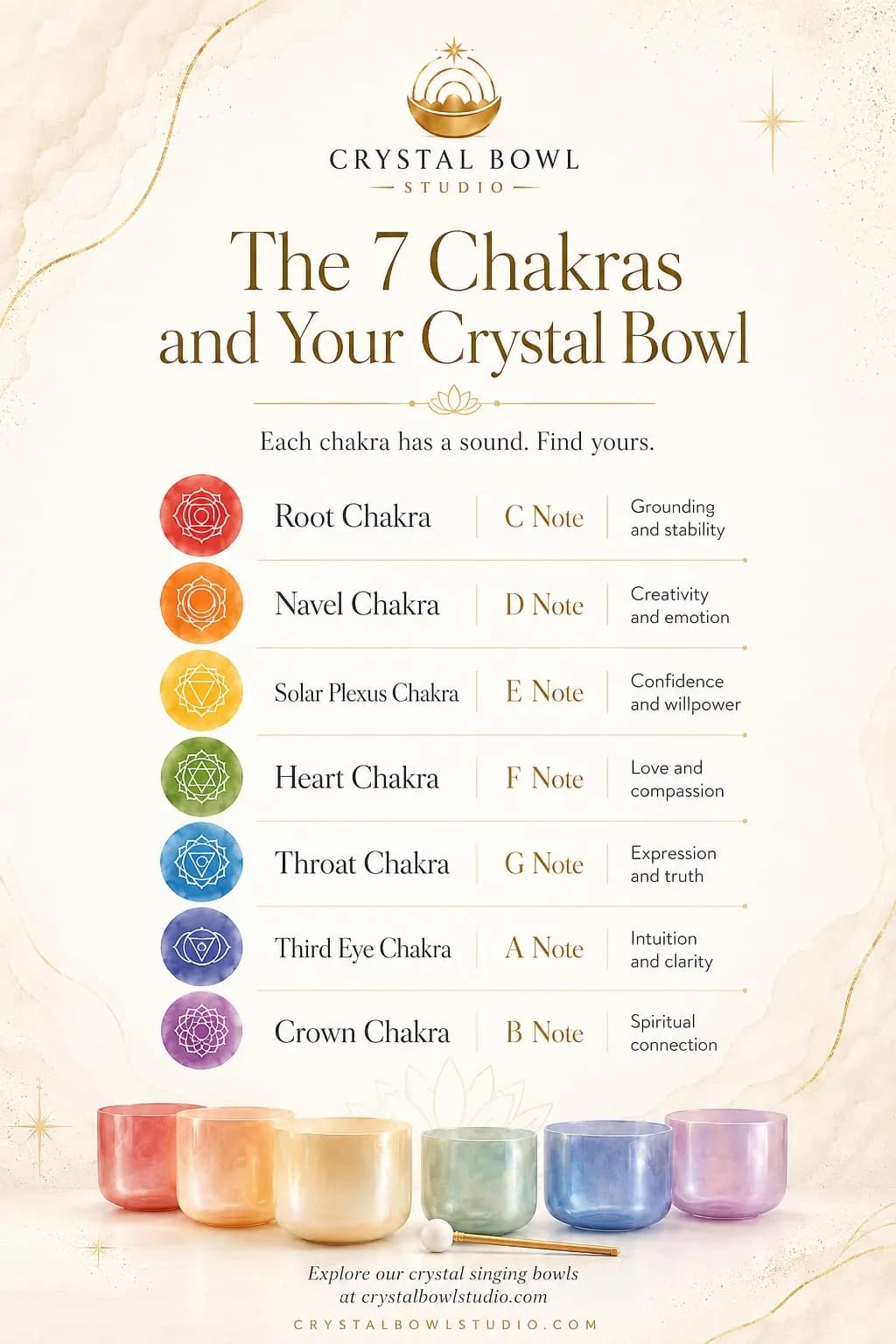
A singing bowl frequency chart takes those musical notes and maps them to the seven chakras. Root chakra gets the C. Crown gets the B. The other five fall in between, in order.
That's the whole concept. For the science of how quartz produces these pitches, read our complete crystal singing bowl frequency guide.
Now here's the part people gloss over and probably shouldn't. This system comes from wellness and energetic tradition. Not from a clinical trial. Nobody has ever proven in a peer-reviewed journal that playing an F bowl fixes your heart chakra the way a surgeon fixes a valve. The honest version of this is that the note-to-chakra map is a practice framework. A way of bringing intention into sound work. A lot of practitioners find it deeply meaningful. A lot of research supports the idea that sound affects the nervous system and helps with relaxation. But it's not medicine. Wondering whether any frequency can truly heal? See what frequency heals the human body.
Keep that distinction in mind, and the chart becomes genuinely useful. Lose it and you end up with a lot of confused expectations.
Singing Bowl Notes and Chakras
This actually goes back further than most people realize.
Indian philosophical traditions have been talking about nada, which means sacred sound, for thousands of years. The idea wasn't that sound was something ears detect and the brain processes. It was that sound is a fundamental force, something that underlies reality itself. Specific tones were thought to resonate with different aspects of consciousness.
The chakra system sits inside that same worldview. Seven main energy centres running along the spine from the base to the top of the head. Each one connected to different aspects of physical, emotional and spiritual experience.
When crystal singing bowls started appearing in Western wellness spaces around the 1980s, practitioners put those two things together. Seven chakras. Seven notes in a Western musical scale. It was an intuitive match. The system that came out of it is what most people now search for as a chakra sounds chart or a singing bowl frequency chart.
One honest caveat though. Not everyone uses the same map. Tibetan singing bowl traditions, especially older Himalayan lineages, sometimes assign notes differently. The C through B chart you're about to see is the most widely used version today, particularly with crystal and quartz bowls. It's a solid foundation. But it's not the only one that exists. You may also see Solfeggio frequencies mentioned. That's a separate system, explained in our guide to Solfeggio vs crystal bowl frequencies.
Crystal Bowl Frequency Chart: Notes, Chakras and Meanings
Here it is.
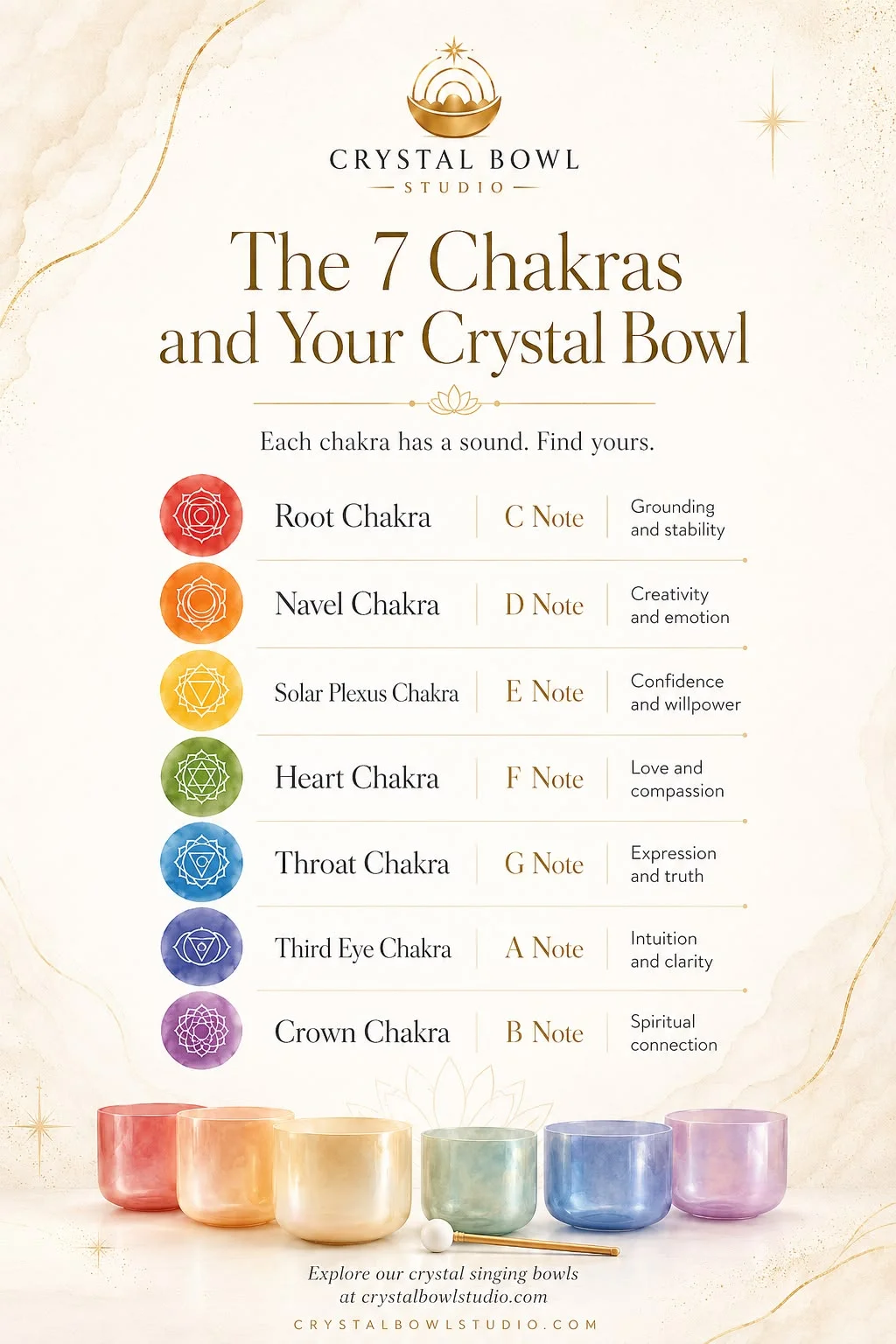
| Chakra | Note | Location | Common Meaning | Practice Intention |
|---|---|---|---|---|
| Root (Muladhara) | C | Base of spine | Grounding, safety, stability | Feeling your body. Landing in the present. Slowing down |
| Sacral (Svadhisthana) | D | Lower abdomen | Creativity, pleasure, flow | Softening. Releasing rigidity. Inviting ease |
| Solar Plexus (Manipura) | E | Upper abdomen | Confidence, personal power, will | Moving through doubt. Strengthening sense of self |
| Heart (Anahata) | F | Centre of chest | Love, compassion, openness | Releasing what's held. Coming back to kindness |
| Throat (Vishuddha) | G | Throat | Expression, truth, communication | Saying the thing. Clearing what goes unsaid |
| Third Eye (Ajna) | A | Between the brows | Intuition, clarity, insight | Trusting what you already know. Going inward |
| Crown (Sahasrara) | B | Top of the head | Stillness, transcendence, connection | Letting go completely. Opening to what's beyond |
A Few Notes on the Chart Itself
The note letter matters more than the octave. A C3 and a C5 are both C. We make bowls in both the 3rd octave and 4th octave. Both connect to the root chakra. What changes between them is how the sound lands in the body. Lower octaves feel heavier, more physical, almost like the floor is vibrating. Higher octaves are lighter, more spacious. The chakra association is the same either way. If that difference matters to you, we go deeper in 3rd octave vs 4th octave crystal singing bowls.
Also, being drawn to one particular bowl isn't a sign something is wrong with the matching chakra. Resonance is personal. It shifts depending on where you are in life, what you're carrying that week, what you're working through. The chart points you somewhere. Your actual response to the sound tells you something too.
Chakra Singing Bowl Notes Explained
There's knowing the chart and then there's watching what actually happens in a room when these notes are played. Different thing.
C, Root Chakra
Low. Round. Physical. A C bowl doesn't ask you to think about grounding. It just does it. People feel it in their legs, their lower back, the soles of their feet. Most sound baths open here. Most yoga teachers who use a single bowl at the start of class reach for this one or the F. When a room is anxious or scattered, a C bowl is what brings it back.
D, Sacral Chakra
Warmer than C. There's a quality of movement in it. D bowls show up a lot in yin settings, in practices around creativity and emotional flow, in sessions where the goal is softening rather than activation. Not dramatic. More like a gradual release.
E, Solar Plexus
Brighter. More forward. An E bowl shifts energy in a room fairly noticeably. Practitioners use it at transition points, during practices around confidence and decision-making, when there's a need to activate rather than settle. It's not a bowl that encourages stillness. It encourages movement.
F, Heart Chakra
This is the one.
Ask any experienced sound healer which single bowl sees the most use across the most contexts, and the F comes up more than any other. Grief work, self-compassion practices, savasana, group sound baths, intimate one-on-one sessions. It works in almost all of them. There's an accessibility to the F note that most people respond to without needing any explanation. If you're going to own one yoga bowl in your entire life, F is the most defensible starting point by a significant margin.
G, Throat Chakra
Used when expression is the theme. Some practitioners open group sessions with a G bowl specifically to signal that authentic presence is welcome here. Others use it in practices built around voice, creative work or clearing whatever has been left unsaid for too long.
A, Third Eye
This is a subtler one. Quieter in effect even when the note itself is clear. A bowls tend to come out later in a session, once a room has already settled into depth. They support inward focus, meditative clarity, the kind of interior stillness where insight sometimes surfaces. Not a note to open with. A note to go deeper with.
B, Crown Chakra
The last note. High, shimmering, long. Most sound healers strike the B bowl at the very end of a session and then just let the silence take over. There's something about that note that feels like permission to release everything accumulated during the session. It's the note that says: you can let go now.
7 Chakra Healing Bowls
Seven bowls. Seven notes. C through B. One per chakra.
That's what a 7 chakra healing bowl set is. A complete palette. Every chakra covered. Full range from the most grounding note to the most expansive one.
Most beginners don't need this right away. Worth saying clearly. One bowl used with real intention will do more than seven bowls left mostly on the shelf.
But for the right person in the right situation, a full set is genuinely the right tool.
- Sound healing practitioners. Offering private sessions or group sound baths. You need flexibility. You need to be able to work with whatever a session calls for. A full chakra set gives you that. Our best-selling option is the 7 Chakra Master Set in the 4th octave.
- Yoga teachers with an intentional sonic practice. You match sound to theme. Grounding class uses the C. Self-love focus uses the F. Voice and expression class uses the G. The full set means you're never reaching for something you don't have.
- Wellness spaces and retreat centres. Anywhere people come specifically to rest, process or transform. Having the full range available matters. Planning a retreat or brand event? We design sound experiences for these too.
- People doing a structured self-inquiry practice. Some practitioners rotate through one bowl per day across a week, using the chakra set as a kind of guided inner survey. It's a real practice. A lot of people find it quietly revealing.
For everyone else: start with one. Build from there.
Should You Buy One Chakra Bowl or a Full Chakra Singing Bowl Set?
Start with one bowl. That's the actual answer for most people reading this.
One bowl played every day for six months will teach you things that seven bowls played occasionally never will. The relationship matters. Getting to know how a single note sounds in your room at six in the morning versus after work. Learning where to strike it for a longer ring. Noticing how the same bowl sounds different on different days. That kind of familiarity is what develops into a real practice.
Choosing a first bowl
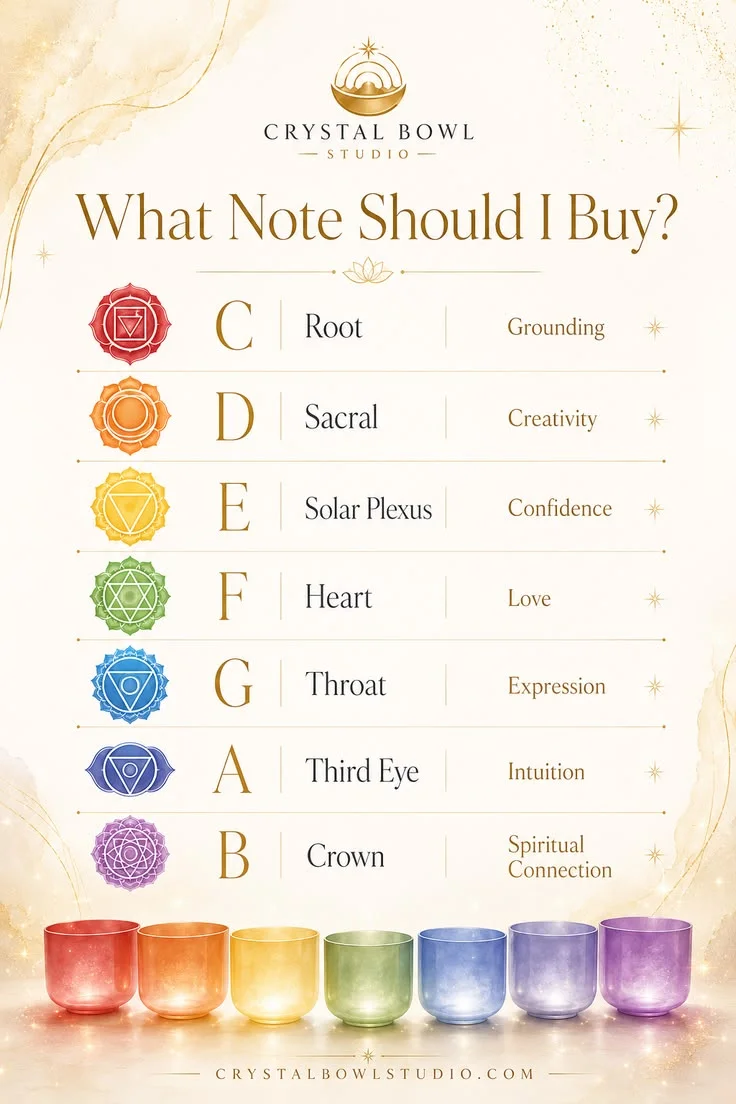
- F (Heart) is where most people end up and where most practitioners suggest starting. Wide appeal, works across almost every context, tends to land immediately with most people who hear it.
- C (Root) makes sense if the reason you're starting is anxiety, restlessness, or a persistent sense of being ungrounded. That low note does something to the nervous system that most people feel without needing it explained.
- B (Crown) is worth considering if you already have an established meditation practice and want something to deepen it. Not usually the first bowl for someone brand new.
And honestly? When you hear the right bowl, you tend to know. Something in you responds before your brain has caught up. That response is real information. Follow it.
When a full chakra set makes sense
You're teaching regularly. You're offering professional sessions. You're running a studio or retreat space. Or you've been working with individual bowls long enough that a complete set is the genuine next step, not just a purchase.
When evaluating any chakra singing bowl set, a few things matter:
- Sustain. The tone should ring clearly and hold for a long time. A bowl that cuts out after a few seconds isn't giving you much to work with.
- No buzz, no distortion. Especially when played at the rim. Run a mallet around the edge and listen carefully. Any crackling or buzzing is a quality issue.
- Blend across the set. The bowls should feel like they belong together. Not like seven strangers in a room. Like seven notes that want to be played near each other.
- Tonal variety. A set where every bowl sounds roughly the same pitch is missing something. Range is part of what makes a set useful.
For a deeper buying walkthrough, see our guide on how to choose a crystal singing bowl.
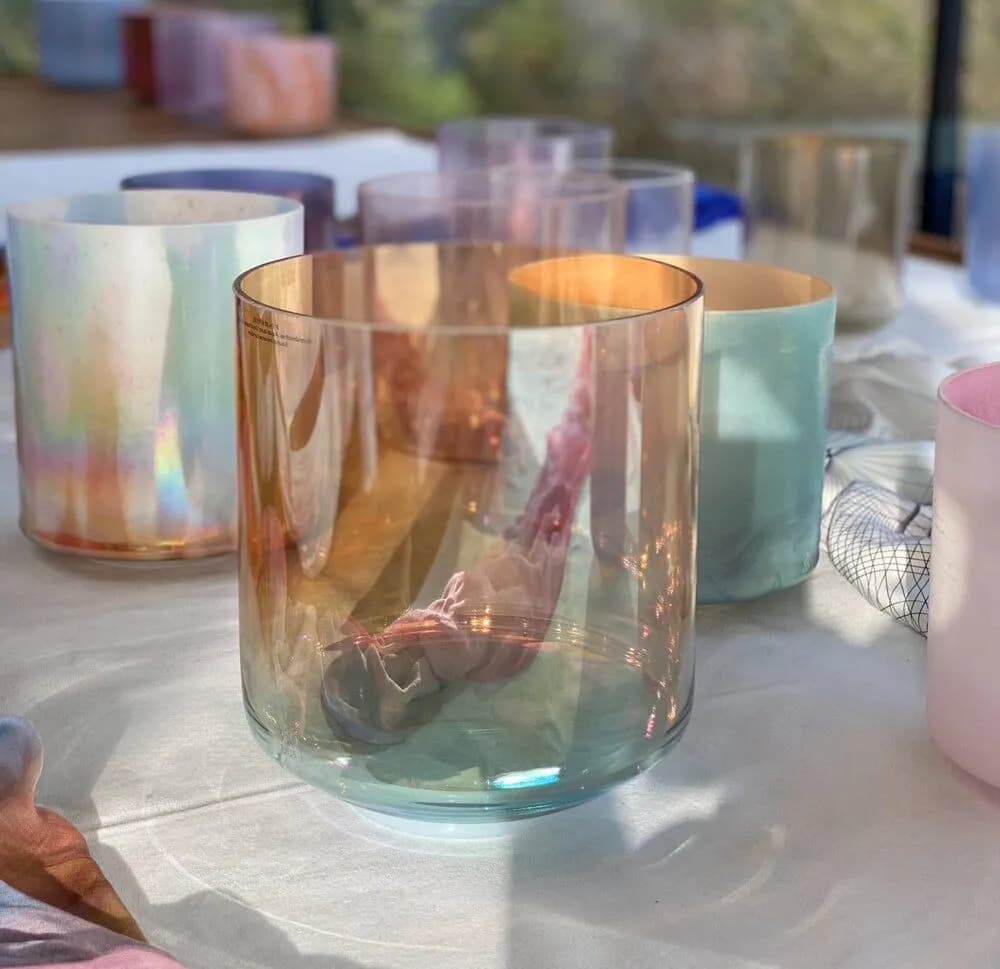
Crystal Bowl Studio carries frosted and clear crystal singing bowls. Frosted are louder, physically resonant, and easier for beginners to play. Clear bowls are more refined, more sensitive, and better suited to experienced practitioners who have developed a feel for the instrument. The difference is something you hear immediately when the bowls are placed side by side.
How to Use Chakra Sound Bowls in Practice
No training needed. No certification. Just a bowl and some quiet.
Intention setting before practice
Strike the bowl once before you begin anything. Meditation, breathwork, yoga, journaling, whatever. Hold what you're working with in mind as the sound rises and fades. That's it. Deceptively simple, genuinely effective.
Breathwork sessions
Play the bowl at the start. The sound gives the nervous system a thread to follow, which makes the transition into breathwork considerably easier. C and F are the most common choices here. Both settle the room without activating it.
Yin yoga or long holds
Strike at the opening of each pose. Let the tone ring out completely before moving on. The bowl fills the hold without the teacher needing to say anything. Students can track the sound instead of tracking discomfort.
Savasana
Single bowl. Slow strikes. Full decay between each one. Do not rush. The silence between strikes is not empty space. It's part of the practice. Some of the most important moments in a savasana happen in the quiet after the bowl has finished ringing.
Full sound bath with a complete chakra set
Start with C. End with B. Three to five minutes per note. Proper silence between transitions. The movement from root to crown follows the natural architecture of the chakra system and gives the whole sound bath a sense of actual journey and direction, which participants feel even if they couldn't articulate why.
Single bowl meditation
Twenty minutes. One bowl. Strike it. Listen until the sound is completely gone, not just quiet but actually gone. Then strike again. Repeat. The note is your only object of attention. No visualisation, no mantra, no framework. Just sound and listening.
This is probably the most powerful use of a chakra bowl, and it requires nothing except the bowl, the time and your attention.
Final Thoughts
Here's the honest version of how most people relate to a singing bowl frequency chart.
At first it feels essential. You want to understand the system before you engage with it. That's reasonable. The chart gives you language, structure, a place to stand.
And then you actually use a bowl for a while.
And the chart starts to matter less. Not because it's wrong. Because something else starts to matter more. The actual sound. How it feels in your body. Which note you reach for on a hard day and which one you want when things are already quiet.
At Crystal Bowl Studio, the most common thing practitioners say after they've been working with bowls for a year or two is some version of: I stopped thinking about the notes so much and just started listening.
That's where the practice actually lives.
Whether you're choosing your first single bowl or putting together a complete chakra singing bowl set, let sound lead the way. The chart gives you a map. Your own experience teaches you the territory.
Browse the Crystal Bowl Studio collection and find the one that sounds right to you.
Frequently Asked Questions
What is a singing bowl frequency chart?
It's a reference guide that connects musical notes to the seven chakras. Each chakra from root to crown gets a specific note, C through B, and crystal singing bowls tuned to those notes are used in meditation, sound healing and yoga. The chart gives practitioners a starting point for choosing bowls and building sessions with intention. It's a framework, not a medical system.
What are the chakra singing bowl notes?
Seven notes, one per chakra, in order: C for the Root, D for the Sacral, E for the Solar Plexus, F for the Heart, G for the Throat, A for the Third Eye, B for the Crown. These are the associations used in most crystal singing bowl sets and sound healing training programs you'll encounter today.
Which singing bowl is used for the root chakra?
A bowl tuned to the note C. It's the lowest note in the chakra system and has a heavy, grounding quality most people feel physically when they hear it. It's typically the first bowl played in a sound bath and probably the most common recommendation for someone dealing with anxiety or a sense of being scattered or ungrounded.
Do I need 7 chakra healing bowls?
Most people don't, not at the start. One bowl used with real consistency will take you further than a full set you're not ready for. A complete set of 7 chakra healing bowls becomes genuinely useful when you're teaching, offering professional sessions, or running a space where having the full range available actually matters for your work.
Are chakra musical notes scientifically proven?
No, not in the clinical sense. The note-to-chakra system comes from wellness and energetic tradition rather than controlled research. There's no peer-reviewed evidence showing that a specific musical note heals a specific chakra in a measurable physiological way. What research does suggest is that sound has real effects on the nervous system, stress response, and mental states. So the bowls are doing something. The specific chakra framework is the layer of meaning practitioners bring to that experience. Both things can be true at once.
References
- Goldsby, T. L., Goldsby, M. E., McWalters, M., & Mills, P. J. (2017). Effects of Singing Bowl Sound Meditation on Mood, Tension, and Well-being: An Observational Study. Journal of Evidence-Based Complementary & Alternative Medicine, 22(3), 401–406.
- Stanhope, J., & Weinstein, P. (2020). The human health effects of singing bowls: A systematic review. Complementary Therapies in Medicine, 51, 102412.
- Historical accounts of nada (sacred sound) within Indian philosophical and Vedic traditions.


.5623a955.svg)


.b76148b1.svg)