

Two bowls. Same note. Completely different sound. That's the thing that trips up almost everyone the first time they shop for crystal bowls. One bowl feels low and heavy, like it's coming up through the floor. The other feels light and right there in front of your face. Both tuned to C, let's say. So why don't they feel anything alike? Octave. That's basically the whole answer, and most people have never thought about it before they start shopping.
At Crystal Bowl Studio we get this question a lot, from total beginners and from folks who've run sound baths for ten-plus years. 3rd octave or 4th octave, which one should I pick? It's not a small detail as an octave decides how a bowl sits in a room, how it plays inside a sound bath. Another point to consider is that you'll still want to pick it up six months from now or it'll just sit on a shelf.
So here's the breakdown. What octave actually means, how 3rd and 4th octave bowls differ in practice, not just on a spec sheet, and which one fits your space. No jargon dump, no big promises, just what you need before spending the money.
What Is an Octave in a Singing Bowl?
Think of a piano. Press a C near the bottom. Now press a C near the top. Same note on paper, but one rumbles and the other practically sparkles. That gap is octave, and it's nowhere near as complicated as it sounds. Just the register a note happens to live in.
Crystal bowls work on the same logic, except instead of 88 keys you're usually dealing with a handful of inches of difference in diameter. A C bowl in a lower octave and a C bowl in a higher octave are, technically, playing the same note. They don't feel anything alike once you actually strike them. The octave number is a rough marker for where that note lands on the pitch ladder, somewhere between deep and grounding on one side and bright and crisp on the other. For the science behind these pitches, read our complete crystal singing bowl frequency guide.
And here's the part most people skip before they buy. Octave doesn't just shift pitch rather it changes how sound physically moves through a room. Lower octave bowls send out a slow, wide wave that takes a beat to fill a space and kind of wraps around you while it's doing it. Higher octave bowls are quicker, more direct, you hear it almost the second it's struck and it stays tight instead of spreading everywhere. Once that one idea clicks, shopping gets a lot less confusing.
What Are 3rd Octave Crystal Bowls?
3rd octave crystal bowls sit lower on the range, usually somewhere in the 10 to 14 inch diameter territory depending on the note, though that varies by maker. Bigger bowls, generally, and the tone matches the size. Full, slow, the kind of sound you feel in your ribcage almost as much as your ears.
Quick rundown of what makes a 3rd octave bowl what it is:
- Deep, full tone that builds rather than hitting all at once
- Slower sound waves, often called grounding
- Larger size, which is really why the pitch drops in the first place
- Good carrying power across bigger rooms
This is why 3rd octave bowls show up so often in sound baths, group circles, yoga studios with tall ceilings. Basically anywhere the goal is filling the whole space. Ever sat in a sound bath where the tone seemed to come from every direction and just hung in the air long after the bowl stopped ringing? Probably a 3rd octave bowl behind that one. If you want that depth, explore our 7 Chakra Master Set in the 3rd octave, or try The 5 Elemental Balance Series in the 3rd octave.
What Are 4th Octave Crystal Bowls?
4th octave bowls live higher up the scale. Smaller, typically closer to 6 to 9 inches across, and the sound is brighter, cleaner. A 3rd octave bowl rolls through a room slowly. A 4th octave bowl cuts straight through it.
What you'll notice with 4th octave bowls:
- Higher, lighter pitch, crisp rather than heavy
- Clearer tone, easier to pick apart when you're listening closely
- Smaller size, which also makes shipping and storage a lot less of a headache
- Works better in tight spaces since the sound doesn't need room to spread
That's the main reason these get pushed toward beginners and home practice so often. It's easy to know what's happening when you experience clear tone and that makes the difference when you're still learning how a bowl responds to your hand. A frosted 4th octave crystal singing bowl is an easy first choice.
Difference Between 3rd and 4th Octave
Here's the difference between 3rd and 4th octave crystal bowls, laid out plainly.
| Factor | 3rd Octave | 4th Octave |
|---|---|---|
| Pitch | Lower | Higher |
| Sound depth | Full, rich, heavy | Light, crisp, clear |
| Volume feel | Builds slowly, fills the room | Direct, immediate |
| Best room size | Medium to large, open rooms | Small to medium |
| Best use case | Sound baths, group work | Personal practice, yoga |
| Beginner suitability | Fine, but can feel like a lot in a tiny room | Usually easier to start on |
Short version. 3rd octave is depth. 4th octave is clarity. Neither one beats the other, they're just meant to do different jobs, and many people end up wanting both eventually.
Which Octave Should You Choose?
This is the actual decision point. Don't ask which octave is "better." Ask which one fits your room and your routine.
3rd octave makes sense if you:
- Run sound baths or attend them regularly
- Practice in a bigger room or open studio
- Want something deep, something grounding
- Need a strong low anchor for a growing set
- Don't mind a bigger bowl eating up shelf space
4th octave makes sense if you:
- Mostly practice at home, in a smaller room
- Are new to this and want something easy to follow by ear
- Teach smaller classes
- Want something light that's easy to move around
- Like a brighter, sharper tone while you play
If you're stuck, think room first. For a wider buying guide, see how to choose a crystal singing bowl. A small bedroom corner and a thirty-person studio call for different bowls, no matter which one sounds nicer to you in isolation. We've had customers buy a 3rd octave bowl because they loved the demo, then realize their apartment couldn't really do it justice. Worth thinking about before you order.
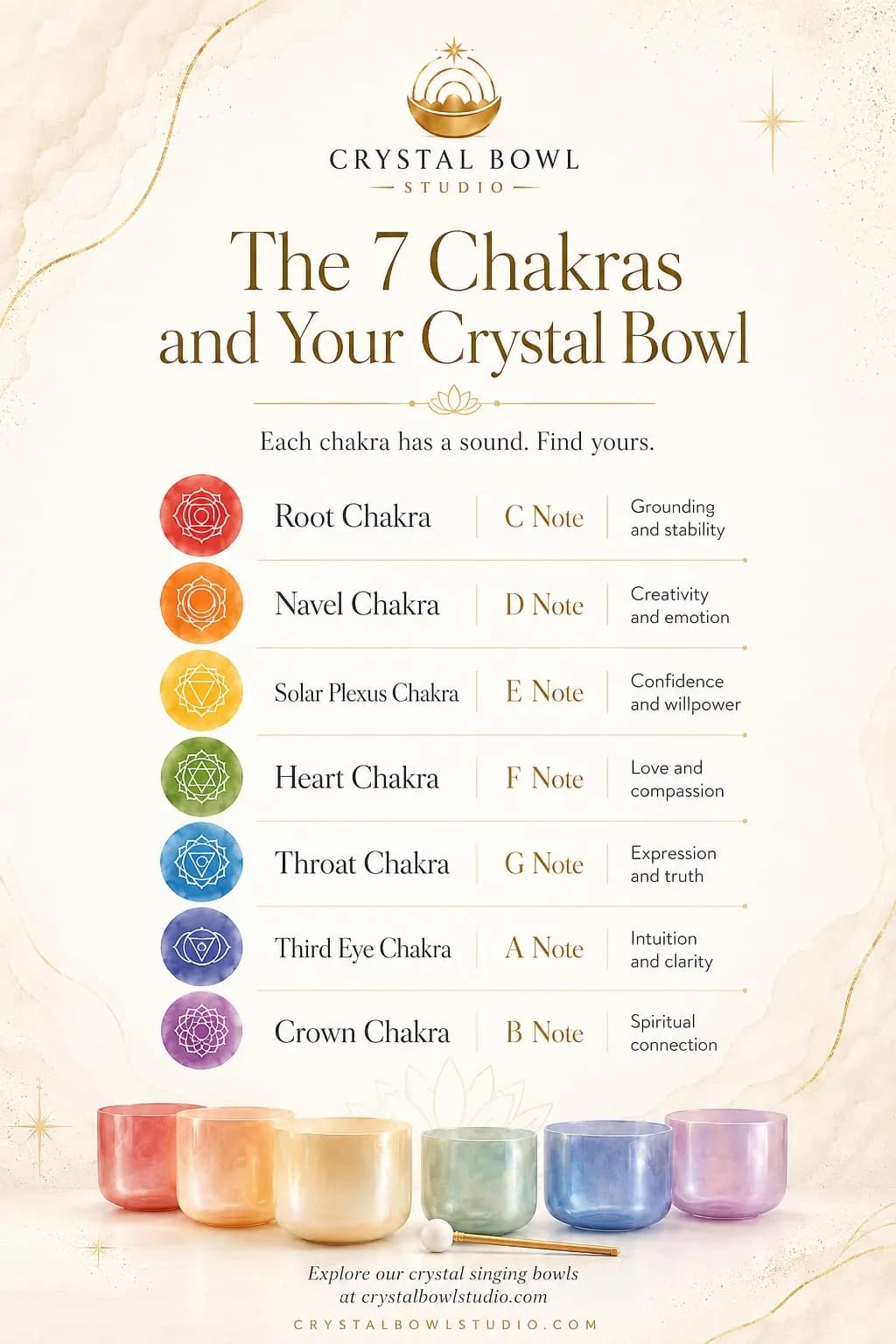
Choosing by note rather than by size? Our crystal bowl frequency chart maps each note to its chakra.
Can You Mix 3rd Octave and 4th Octave Crystal Bowls?
Yes. People do this constantly, on purpose. It's one of the easier ways to add real contrast to a session.
A 3rd octave bowl gives you a low, grounded base. Layer a 4th octave bowl on top and you get brightness and lift. Played together, or one after the other, the contrast builds something fuller than either bowl manages alone. That's a big reason practitioners build sets across multiple octaves instead of sticking with one register forever.
There's no fixed formula here. Some start low and climb. Some go the opposite way. Some just let both ring out together and see what happens. Depends on the mood you're chasing that day, honestly, and sometimes it depends on what the room sounds like once people are actually sitting in it.
Can a Bowl Sing in 4 Octaves?
Let's settle this since it comes up a lot. No, a single crystal bowl does not sing across four octaves. One bowl, one main note, one main octave, that's how they're tuned and that's not really up for debate.
What a bowl can do is throw off overtones, secondary harmonics that ring above the main note while it's playing. Sometimes that creates the impression of a richer, layered sound, almost like it's doing more than one thing at once. But that's harmonic shimmer, not the bowl actually hopping between four different octaves.
If you genuinely want range across multiple octaves, that means owning more than one bowl, each tuned differently. Not one bowl trying to cover everything by itself. Which is exactly why people slowly build small collections over time, usually one bowl at a time as budget allows, instead of expecting a single bowl to do it all.

Final Thoughts
Octave is easy to ignore when you're new to this, but it ends up shaping almost everything about how a bowl feels in your hands and in your room. 3rd octave brings depth and weight, great for sound baths and bigger spaces. 4th octave brings clarity and ease, great for personal practice and tighter rooms.
At Crystal Bowl Studio we keep coming back to the same three questions with people. What room are you actually using, what kind of sound are you chasing, and how do you practice day to day. There's no universal right answer here, just the one that fits what you're actually doing. If you're still on the fence, go browse 3rd octave and 4th octave bowls side by side at Crystal Bowl Studio and see which tone actually grabs you, sometimes that's the only way to know for sure.
Frequently Asked Questions
What does octave mean in a singing bowl?
When it comes to understanding octave in singing bowl, it's the pitch register a note sits in, lower and deeper or higher and lighter. Two bowls can share the same note and still sound totally different depending on octave.
What is the difference between 3rd and 4th octave crystal bowls?
3rd octave bowls are deeper, fuller, lower-pitched, good for larger rooms and group work. 4th octave bowls are brighter, clearer, higher-pitched, good for smaller rooms and personal practice.
Are 3rd octave crystal bowls better?
Not really. They're better for certain situations, like sound baths and bigger spaces. "Better" depends on your room and what you're trying to do with the sound.
Are 4th octave crystal bowls good for beginners?
Usually, yes. The clearer tone makes it simpler to hear what's happening as you play, and that helps a lot early on.
Can one crystal singing bowl sing in 4 octaves?
No. One bowl, one main note, one main octave. It can produce overtones that add texture, but that's not the same as actually playing across four separate octaves.


.5623a955.svg)


.b76148b1.svg)