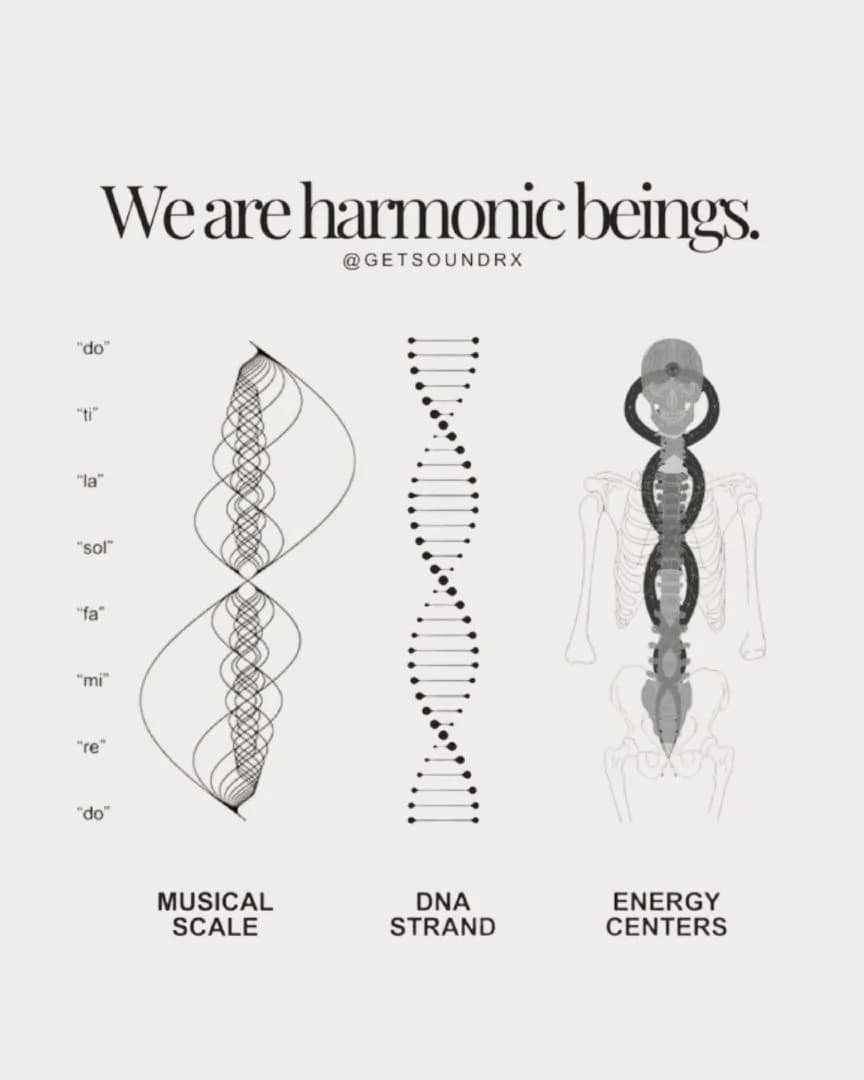

Quartz crystal did something to sound healing that older traditions hadn't quite managed: it made the tone measurable. These bowls don't produce music in any conventional sense. Run a mallet around the rim and what comes back isn't just sound - it's a sustained, physically present frequency that moves through air, through water, through the connective tissue of whoever's sitting nearby. For anyone building a serious sound healing practice, crystal singing bowl frequency isn't background knowledge. It's the whole foundation. This guide covers what frequencies these bowls actually produce, how to read a crystal bowl Hz chart, the real differences between 432 Hz, 440 Hz and 528 Hz tuning systems, and what overtones do to the listening experience from the first strike through the long sustain.
What Frequencies Do Crystal Singing Bowls Actually Produce?
Quartz singing bowls are formed from quartz crystal sand. When the mallet circles the rim, the bowl wall begins to flex — the rate of that flexion determined by diameter, wall thickness, and material density. That's the singing bowl frequency: a cycle-per-second measurement, expressed in hertz, of how fast the bowl vibrates. Larger bowls flex slowly, so they produce lower tones. Smaller bowls flex faster. Simple physics, with significant practical consequences.
But the fundamental note you hear isn't the whole sound. Above it sits a series of upper partials — crystal singing bowl overtones — radiating simultaneously from the same bowl. These are what give quartz instruments their signature layered shimmer. Inside a sound bath, the overtones don't just fill a room. They move through it, around it. People often describe the sensation as being surrounded rather than simply listening.
Singing Bowl Notes and Frequencies: The Full Reference Chart
Contemporary sound healing maps each note of the Western scale to one of the seven major chakras and to a corresponding hertz value. The chart below reflects Pythagorean tuning — not equal temperament — which explains why these numbers differ slightly from standard concert pitch.
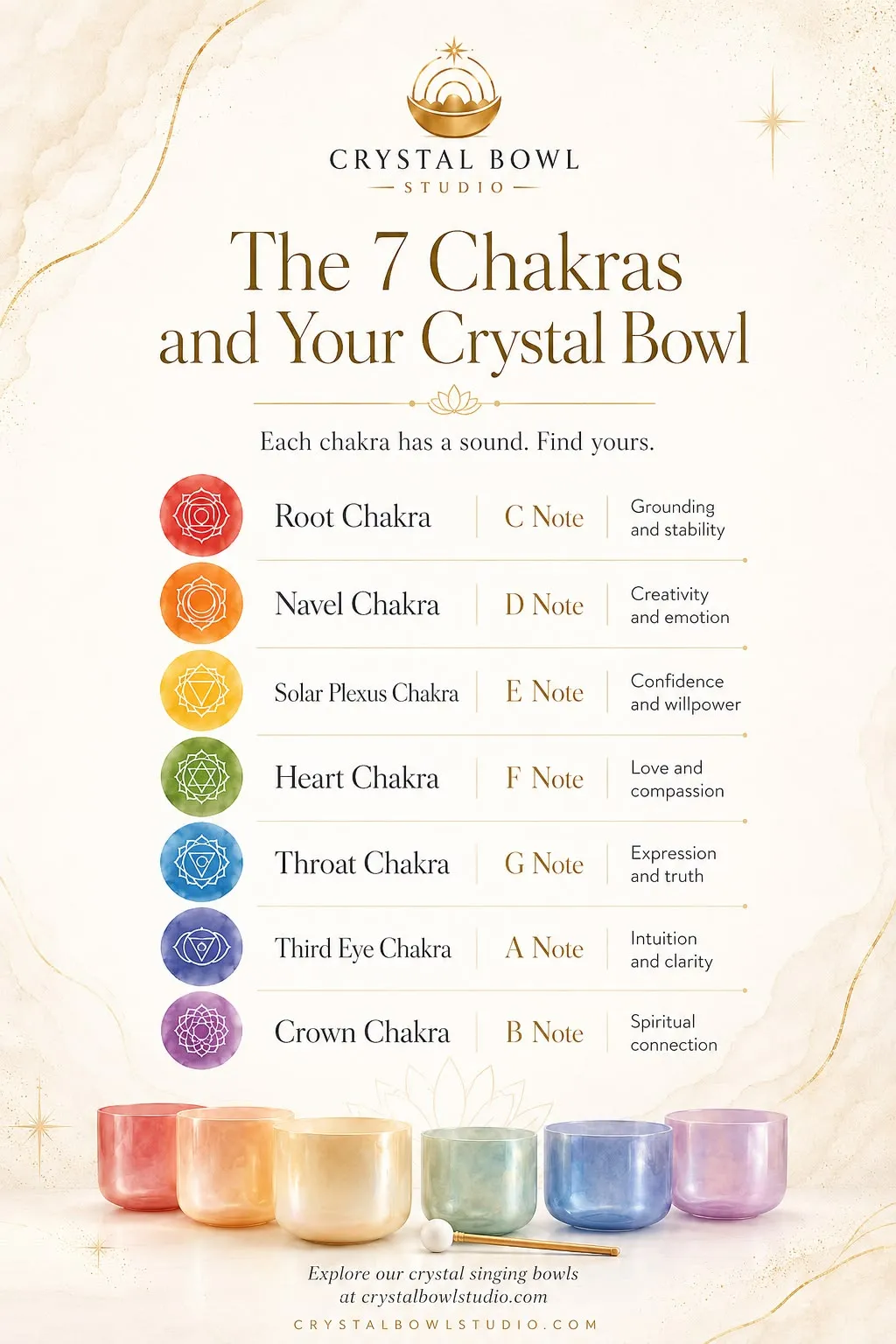
The singing bowl notes and frequencies system used here isn't arbitrary. Pythagorean tuning carries a different mathematical relationship between intervals than equal temperament does, and that matters in layered bowl work — particularly when multiple bowls interact and their overtones begin to overlap.
Shop our 7-Chakra Singing Bowl Sets
Pre-curated sets aligned to the full frequency spectrum, designed for both beginners and practitioners.
Design your own Singing Bowl Sets
The 432 Hz Singing Bowl: A Different Way of Listening
Lower the concert reference pitch from A 440 Hz to A 432 Hz and every note in the scale drops by a small but audible margin. That's the 432 Hz singing bowl tradition in a single sentence. What practitioners actually report after years of working with this tuning is harder to reduce: a consistent description of warmth, of roundness, of a quality that requires less effort to rest inside than standard pitch does.
The scientific case for 432 Hz being objectively superior remains unresolved. That's worth stating plainly. But the subjective pattern — accumulated across thousands of practitioners and an enormous body of listening sessions — is coherent enough that dismissing it as placebo becomes its own kind of assumption. A significant number of listeners move into relaxed states faster with 432 Hz bowl tones than with 440 Hz equivalents. While 432 Hz is often described as "aligned with nature," this idea is better understood as philosophical rather than strictly scientific. Proponents point to mathematical patterns such as the Fibonacci sequence, introduced by Leonardo Fibonacci, and the golden ratio, which appear widely in natural forms including plant growth, spiral galaxies, and biological structures. These patterns reflect principles of proportion, efficiency, and coherence in nature.
In the field of acoustics, pioneers like Ernst Chladni and later cymatics researchers such as Hans Jenny demonstrated that sound frequencies can organize matter into geometric patterns, reinforcing the idea that vibration and structure are closely linked. Some modern sound practitioners extend this framework to suggest that certain tunings, including 432 Hz, may feel more harmonious or balanced to the human system.
However, it is important to note that there is currently no scientific evidence directly linking 432 Hz to the Fibonacci sequence or proving it as a universal "natural frequency." Instead, 432 Hz can be understood as a tuning that some listeners subjectively experience as softer, more coherent, and calming compared to the modern standard of 440 Hz. This distinction allows for an informed and grounded appreciation of its potential benefits without overstating scientific claims.
References
- Calamassi, M. G., & Pomponi, A. (2019). Music tuned to 440 Hz versus 432 Hz and the health effects: A double-blind cross-over pilot study.
- Di Nasso, G., et al. (2016). Influence of 432 Hz music on the perception of anxiety during dental treatment: A randomized controlled trial.
- International Organization for Standardization (ISO 16:1975). Standard tuning pitch (A = 440 Hz).
432 Hz is our standard tuning. If you would like your bowls in an alternative frequency, please leave a note on your order at checkout and we can customize your order to your preferred frequency.
The 528 Hz Crystal Singing Bowl: Transformation Frequency
In the solfeggio tradition, 528 Hz occupies an unusual amount of cultural space. Called the Mi syllable in original Gregorian notation, it got re-labelled the "repair frequency" or "love frequency" somewhere along the way — partly through cymatics research, which examines how sound organises matter into visible patterns, and partly through cellular biology work on how specific frequency ranges affect water.
The 528 Hz crystal singing bowl has attracted more attention and more scepticism than almost any other tool in sound healing, often simultaneously. The DNA repair claim — the one that circulates most widely — traces back to 2010 research on sound frequencies and water surface tension in contaminated samples. The evidence chain from those findings to cellular repair in living tissue is still being assembled. That's not a dismissal. It's just where the science currently sits.
What is consistently documented, across independent practitioners working in different traditions: clients in 528 Hz bowl sessions commonly report warmth concentrated in the heart and solar plexus, emotional release, and an unusual quality of ease that persists after the session ends. Patterns that repeat across thousands of independent observations tend to pull researchers in eventually.
Understanding the Chakra Singing Bowl Frequency Chart
The chakra singing bowl frequency chart is essentially a translation layer — converting the body's traditional energy anatomy into a musical map. Each of the seven primary chakras corresponds to a specific note, and working with a bowl tuned to that note during bodywork or meditation is understood in energetic medicine traditions to address whatever imbalances or qualities are associated with that centre.
Practically: the crystal bowl 396 Hz, 417 Hz, and 639 Hz frequencies align respectively with the root, sacral, and heart chakras within the solfeggio system. Practitioners building a full chakra set tend to source bowls at each of these frequencies, constructing what amounts to a tonal map of the human body — starting at the earth-grounded root and moving upward to the crown.
New to Singing Bowls? Start with our Beginner's Starter Set here.
Solfeggio Frequencies and the Crystal Bowl
Solfeggio frequencies predate the contemporary wellness industry by centuries. They appear in Gregorian chant and in mathematical structures attributed to Pythagorean traditions. Their re-entry into modern practice happened largely in the 1990s, when researchers began cross-referencing these historical tones with physiological response data. In bowl work, the most-used values are 396, 417, 528, 639, 741, 852, and 963 Hz.
A skilled bowl maker can tune a quartz instrument precisely to any of these frequencies. Precision matters more here than in general musical contexts. The difference between a bowl at 528 Hz and one at 525 Hz is small — an untrained ear won't immediately name it. But in a session where other solfeggio bowls are present, the interaction between resonance patterns will be noticeably different. Three hertz is enough.
Quartz Bowl Octave Tuning: Why Octave Matters
This is the factor most beginners overlook entirely. Quartz bowl octave tuning determines where in the body a tone is felt, not just what note is playing. A C bowl exists across at least four octaves in common production. Same note. Radically different experience.
Third octave C bowls produce slow, heavy, physically felt tones — the kind of sound that registers in the pelvis and low abdomen. Fifth octave C bowls are light, bright, almost aerial. Most experienced practitioners don't stay in one octave. They move deliberately — lower bowls to open and ground at the beginning of a session, higher bowls to clear and lift toward the close. Understanding octave as a practical tool, not just a pitch designation, changes how you build a practice.
Shop all our 3rd Octave and 4th Octave Collection here.
Reading Crystal Singing Bowl Overtones
Every bowl simultaneously produces a fundamental tone and a series of higher partials. In a C bowl, the fundamental is clear. Riding above it is a soft G. Above that, another C an octave higher. Above those, progressively fainter partials that together give the bowl its individual sonic character.
When multiple bowls play at the same time, their overtones start to interact. Two bowls tuned a fifth apart share an overtone — their blend feels resolved, even restful, in a way that consonant intervals consistently do. Bowls tuned a semitone apart generate a beating interference pattern. Some practitioners use that deliberately: the unresolved tension building until it releases into a wider, cleaner tone. Knowing your bowl's overtone profile isn't academic. It changes every compositional decision you make in a session.
A Practical Starting Point
Frequency work with crystal bowls is genuinely layered. That can feel like a lot when you're starting. The practical entry point is simpler than it looks: pick one note. The note that corresponds to whatever aspect of the body or experience you most want to work with. Learn that bowl thoroughly — its sustain, its overtone profile, how pressure and mallet angle change the quality of the sound. Let it get familiar before adding anything else.
The chakra singing bowl frequency chart is a map, not a shopping list. It's most useful once you have at least one location on it well in hand — one bowl, one note, one body of experience that everything else can be measured against.
To go deeper on the physiological side of this topic, the companion article on what frequency heals the human body takes the research further than this guide does.
Frequently Asked Questions
Q1 - What Hz do crystal singing bowls typically produce?
Most crystal singing bowls produce tones between 256 Hz and 960 Hz, depending on size and octave. Larger bowls sit in the lower range; smaller bowls ring higher. Specific frequencies, including solfeggio tunings such as 528 Hz, 440 Hz or 432 Hz, can be requested when ordering from a specialist maker.
Q2 - What is the difference between a 432 Hz and a 440 Hz singing bowl?
The difference is in the tuning reference. A 440 Hz bowl is tuned to standard concert pitch. A 432 Hz bowl shifts the entire scale down by eight hertz, producing a slightly warmer tonal quality that many practitioners prefer for extended listening. Both are valid; the choice comes down to personal preference and the nature of your practice.
Q3 - How do I read a crystal bowl Hz chart?
A crystal bowl Hz chart maps each musical note to its frequency in hertz. Start by identifying your bowl's note, then cross-reference its octave. In most sound healing versions, the chart will also show the associated chakra and a suggested intention for that tone.
Q5 - What are crystal singing bowl overtones?
Overtones are the higher harmonics that sound above the fundamental note. When a crystal bowl rings, you hear not just the primary pitch but a shimmering layer of related frequencies above it. These contribute to the three-dimensional, immersive quality of the sound, and they vary between bowls depending on size, thickness, and quartz purity.
Q6 - Can a crystal singing bowl be tuned to solfeggio frequencies like 528 Hz?
Yes. Quality bowl makers can tune quartz instruments to specific solfeggio frequencies, including 396 Hz, 528 Hz, 639 Hz, and others. At Crystal Bowl Studio, we work with clients to identify the frequencies most relevant to their practice and source or commission bowls accordingly.



.5623a955.svg)


.b76148b1.svg)