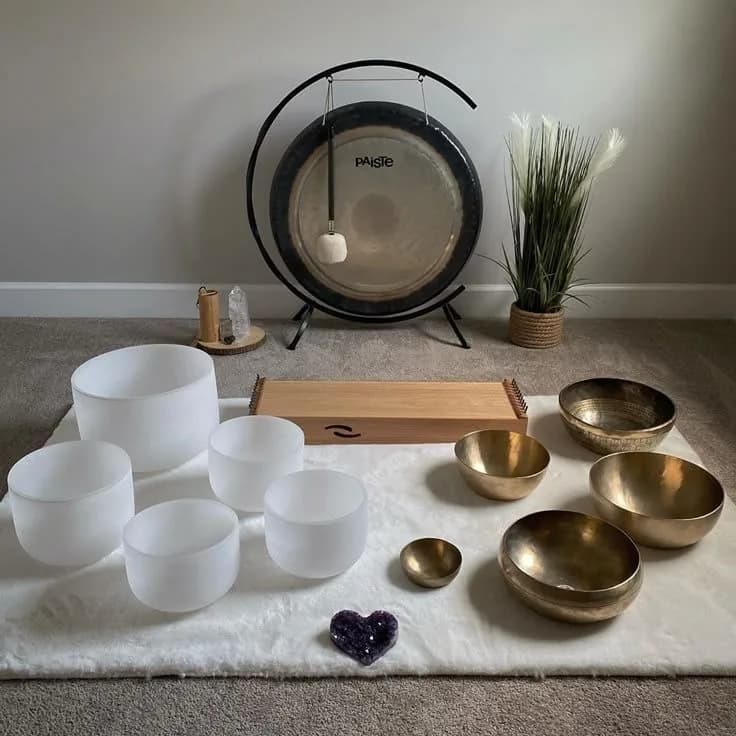

Put the two side by side and the question answers itself visually, before you've heard a note. One bowl is heavy, worked metal, carrying the physical memory of being hammered. The other is smooth quartz, almost luminous, crafted by a craftsman's hands. Both will stop a room when played. The question of Crystal vs Tibetan singing bowls isn't really about which one is better. It's about what kind of intention and sound you're building a practice around, and what that practice actually needs from an instrument.
Where Each Bowl Comes From
Tibetan Singing Bowls
The Himalayan bowl vs Crystal bowl comparison starts in radically different origin points. Tibetan bowls, also called Himalayan bowls, have been central to Buddhist ceremony and meditation practice for centuries, possibly considerably longer than the historical record clearly documents. Traditional bowls are hand-hammered from a multi-metal alloy. The most historically referenced formulation uses seven metals mapped to seven celestial bodies: gold to the sun, silver to the moon, copper to Venus, iron to Mars, mercury to Mercury, tin to Jupiter, lead to Saturn.
Contemporary production is more varied. Some bowls are still hand-hammered by craftsmen working in traditional methods. Others are machine-made from single-metal or three-metal compositions. That distinction matters acoustically: the harmonic complexity of a hand-hammered multi-metal bowl is genuinely different from a machine-pressed version, and experienced players can usually hear it immediately.
Crystal Singing Bowls
Crystal bowls are a modern instrument. Widespread use began in the 1990s, which makes them young by any comparison with Himalayan bowls. They're made from quartz, either crushed quartz fused at high temperature into the frosted variety, or purer crystalline quartz used for clear bowls. Some incorporate precious metals or gemstones fused into the quartz during manufacture; these are the alchemy bowls, a category with its own distinct tonal character and substantially higher price point.
Crystal singing bowl vs metal bowl construction produces different acoustic outcomes by fundamental material differences. Quartz and multi-metal alloy vibrate differently. That's the whole explanation for why the two instruments sound the way they do.
The Sound: What Each Bowl Actually Does
This is where the singing bowl comparison guide becomes most useful, and where most purchase decisions are actually made.
Tibetan Bowl Sound
A quality hand-hammered Tibetan Bowl produces a tone that's difficult to describe cleanly because it's acoustically complex by nature. Multiple frequencies and overtones emerge simultaneously, interacting with one another to create the characteristic rhythmic pulsing often called the wobble, a subtle oscillation that gives Himalayan bowls their distinctive sense of movement and depth. The result is warmth, texture, and an organic quality that feels almost alive. Practitioners who work primarily with Tibetan bowls often talk about the sound being immediately grounding: a sound that draws attention inward and into the body rather than outward into space.
Dense. Harmonically rich. Less focused on precision of pitch, and not trying to be.
Crystal Bowl Sound
A Crystal Bowl moves differently through a room. The fundamental tone is cleaner, more sustained, the overtones are present and more ordered and spacious, producing the shimmer that makes crystal bowls feel immersive and expansive rather than texturally dense. People often describe crystal bowl sound as: clear, penetrating, spacious, expansive, luminous.
Where Tibetan bowls create depth and movement, crystal bowls create openness and continuity. The sound does not compete for attention. It creates space around it.
Read more: What Frequency Heals the Human Body?
Full Comparison: Crystal vs Tibetan Singing Bowls
- Material — Crystal: Quartz crystal (frosted or clear). Tibetan: Multi-metal alloy (hand-hammered or machine-made).
- Origin — Crystal: Modern instrument (1990s onward). Tibetan: Ancient Himalayan tradition.
- Tone quality — Crystal: Pure, sustained, clear fundamental. Tibetan: Rich, complex, beating partials.
- Overtone profile — Crystal: Ordered shimmer, immersive expansive quality. Tibetan: Dense harmonics, organic warmth.
- Frequency precision — Crystal: Measurable Hz, tunable to solfeggio. Tibetan: Less precise, more variable.
- Portability — Crystal: Lighter, more fragile. Tibetan: Heavier, robust.
- Durability — Crystal: Fragile (clear bowls especially). Tibetan: Durable.
- Price range — Crystal: Mid to high (alchemy bowls very high). Tibetan: Wide range depending on quality.
- Sound bath use — Crystal: Excellent for large group sessions. Tibetan: Good, especially smaller groups.
- Clinical / therapy — Crystal: Preferred for precision frequency work. Tibetan: Used in general sound therapy.
- Meditation style — Crystal: Open, expansive, light quality. Tibetan: Grounded, warm, traditional.
- Learning curve — Crystal: Moderate (technique matters). Tibetan: Low (forgiving to play).
- Cultural connection — Crystal: Neutral, contemporary. Tibetan: Tibetan Buddhist tradition.
Ready to build a set? Browse our Design Your Own bowl sets.
Which Singing Bowl Is Better for Meditation?
It depends almost entirely on how you practise meditation.
If your practice is more body-centred, with attention resting on breath, sensation, embodiment, or grounding, Tibetan bowls often feel naturally supportive. Their layered overtones, warmth, and shifting harmonic texture tend to draw awareness inward and downward into the felt experience of the body. There is density to the experience. Weight. Presence. For grounding and ritual, many meditators find themselves reaching first for metal bowls.
Open-awareness practice often feels different. If your meditation is more expansive and spacious — tracking the field of perception and awareness rather than specific sensation — crystal singing bowls can offer a different quality of support. The sustained tone, clearer fundamental, and longer sustain create an environment that feels easier to rest inside. People often describe crystal bowl sound as opening space rather than filling it.
Crystal Bowl or Tibetan Bowl for Beginners?
Practically speaking, Tibetan bowls win this comparison. The crystal bowl or Tibetan bowl for beginners question tends to resolve toward metal for one reason above all others: durability. A Tibetan bowl is forgiving of imperfect technique. Strike it wrong and you get a less beautiful sound. Strike a crystal bowl hard and you may crack it, and crystal bowls are not cheap.
Frosted crystal bowls are a meaningful exception to that general rule. They're considerably more robust than clear quartz, more forgiving of technique errors, and more accessible in price. For someone drawn to crystal bowls specifically — whether for the frequency precision, or simply because the sound calls to them — a crystal bowl in the 6 to 8 inch range is a reasonable starting point. Technique comes with practice; a few focused sessions is usually enough to get a consistent tone.
Which Singing Bowl for Chakra Healing?
Crystal bowls have a structural advantage in chakra work that Tibetan bowls don't replicate well. The answer to which singing bowl for chakra healing is largely determined by the question of precision. Crystal bowls are manufactured to specific, measurable frequencies — a C bowl at 256 or 261 Hz, a G bowl at 384 or 392 Hz. Those values correspond directly to the notes traditionally mapped onto specific chakras.
Tibetan bowls stimulate the whole system harmonically. That has its own value: broad tonal saturation, an overall settling of the nervous system. But if a practitioner wants to direct work at a specific energetic centre with frequency precision, they're reaching for crystal. That's where the instrument's nature and the method's requirements align.
Metal vs Crystal Bowl Sound Therapy
In clinical and professional therapeutic settings, metal vs crystal bowl sound therapy is increasingly not a choice between the two at all. Many experienced sound therapists use both within a single session, each for what it does best.
The opening strike of a Tibetan bowl creates immediate acoustic presence. That dense, complex tone arrives quickly and commands the space. Crystal bowls then take over for the sustained frequency work that forms the core of most therapeutic sessions, holding specific tones long enough for the nervous system to respond. At the close, a Tibetan bowl often brings the return — grounded and warm — pulling the listener back into ordinary awareness.
The two instruments have different gravitational pulls. Knowing when to use each is part of what distinguishes experienced therapeutic practitioners from people who just own bowls.
Buy Crystal or Metal Singing Bowl: A Practical Decision Framework
Three questions, answered honestly, usually resolve the buy crystal or metal singing bowl decision without much remaining uncertainty:
- What's the primary purpose? Precision frequency work and clinical sound therapy: crystal. Personal meditation, ceremonial use, or general sound baths where exact frequency matters less: either works, and what you're drawn to should carry real weight.
- How will you handle it? Travel regularly, pack and unpack the bowl, work in spaces where accidents happen — and the Tibetan bowl will survive all of that more reliably. Crystal bowls, especially clear quartz, require care.
- What does your nervous system prefer? Listen to both before buying if there's any way to do so. The bowl you'll actually practice with every day is the one that sounds right to you, not the one with the most impressive specifications.
The difference between Crystal and Tibetan bowl comes down to acoustic personality and historical lineage. Both traditions are alive, technical, and genuinely effective. Your practice has a character already, even if you're just beginning to discover it. One of these instruments will fit that character more naturally than the other. And if it turns out both fit, that's a practice worth building carefully.
Frequently Asked Questions
What is the main difference between a Crystal and a Tibetan singing bowl?
Material and sound character, primarily. Crystal singing bowls are made from 99.9% pure quartz and produce a clean, sustained, penetrating tone. Tibetan or Himalayan bowls are hand-hammered from blended metal and produce a warmer, more complex sound with layered overtones. Both are used for meditation and therapeutic practice, but they feel and sound quite different in use.
Which singing bowl is better for chakra healing?
Crystal bowls are generally more practical for structured chakra work because they are tuned to specific musical notes that correspond directly to the seven energy centres. Tibetan bowls produce multiple simultaneous tones and are less suited to precise single-chakra targeting, though many practitioners use them intuitively with excellent results.
Are crystal singing bowls more fragile than Tibetan bowls?
Yes. Quartz is rigid rather than malleable, which means a drop onto a hard surface can shatter a crystal bowl. A quality carrying case is essential. Metal Himalayan bowls are significantly more resilient and can be transported without special protective equipment.
Which type of singing bowl is better for beginners?
Both are accessible for beginners. Frosted crystal bowls tend to be particularly forgiving in technique; they produce a satisfying sound even with inconsistent pressure or an imperfect strike. Tibetan bowls are also beginner-friendly and often more affordable at entry level. The most useful guide is which sound moves you when you hear it.
Can I use a crystal and a Tibetan singing bowl in the same session?
Yes, and the combination can be genuinely powerful. The contrast in tonal character — earthy and complex versus pure and sustained — gives a session additional range and texture. Many experienced practitioners open with Himalayan bowls for grounding and transition to crystal for deepening. It takes some experimentation to find a sequence that flows naturally, but the results are often worth it.



.5623a955.svg)


.b76148b1.svg)